


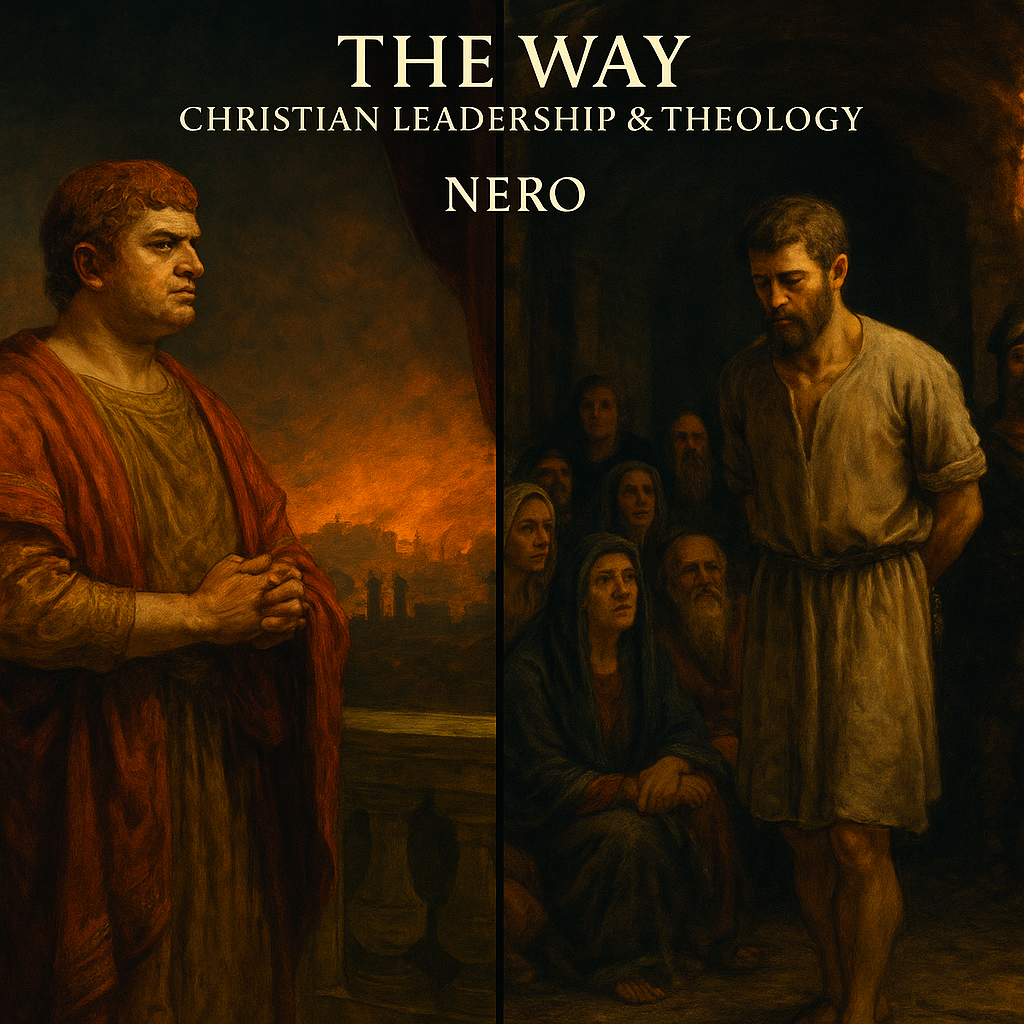
🕊️ The Way | Christian Leadership & Theology Series
Scripture Focus: Philippians 1:12–14; 2 Timothy 4:6–8; Romans 13:1–7 (written during his reign)
Approximate Date: Emperor of Rome, A.D. 54–68
Historical Context: Early Imperial Rome; the first official persecution of Christians.
A Prince of Promise, a Ruler of Ruin
Nero Claudius Caesar Augustus Germanicus ascended the throne at just 17 years old after the death of his stepfather, Emperor Claudius. He began with promise — the tutelage of Seneca the philosopher and Burrus the Praetorian prefect guided his early reforms. The first years of Nero’s reign were marked by justice, leniency, and even artistic patronage.
But the young emperor’s promise gave way to pride. The philosopher-king turned performer, the prince of peace became a tyrant of terror. Power, unrestrained by principle, began to consume him.
Nero’s thirst for glory eclipsed his grasp of governance. Obsessed with theatre, music, and acclaim, he fancied himself an actor on the world’s stage. He sang while Rome burned — quite literally.
Fire and Fury
In A.D. 64, a massive fire swept through Rome, destroying ten of the city’s fourteen districts. Ancient historians Tacitus and Suetonius note that many suspected Nero himself ordered the fire to clear land for his extravagant palace, the Domus Aurea (Golden House). Whether or not he caused it, Nero needed a scapegoat.
He found one in the Christians — a small, misunderstood sect already despised for their refusal to worship Rome’s gods. Nero accused them of arson, unleashing the first imperial persecution of Christians.
Tacitus writes:
“Mockery of every sort was added to their deaths. Covered with the skins of beasts, they were torn by dogs and perished, or were nailed to crosses, or doomed to the flames.” (Annals 15.44)
It was under this atmosphere that Paul wrote from prison, likely facing death under Nero’s decree. When he wrote, “I am already being poured out like a drink offering, and the time of my departure is near” (2 Tim. 4:6), it was Nero’s sword he awaited.
To many, Nero was unstoppable. But history — and providence — proved otherwise. His tyranny consumed him as he had consumed others. When rebellion erupted, Nero fled Rome and, abandoned by the Senate, took his own life in A.D. 68, reportedly uttering, “What an artist dies in me.”
