


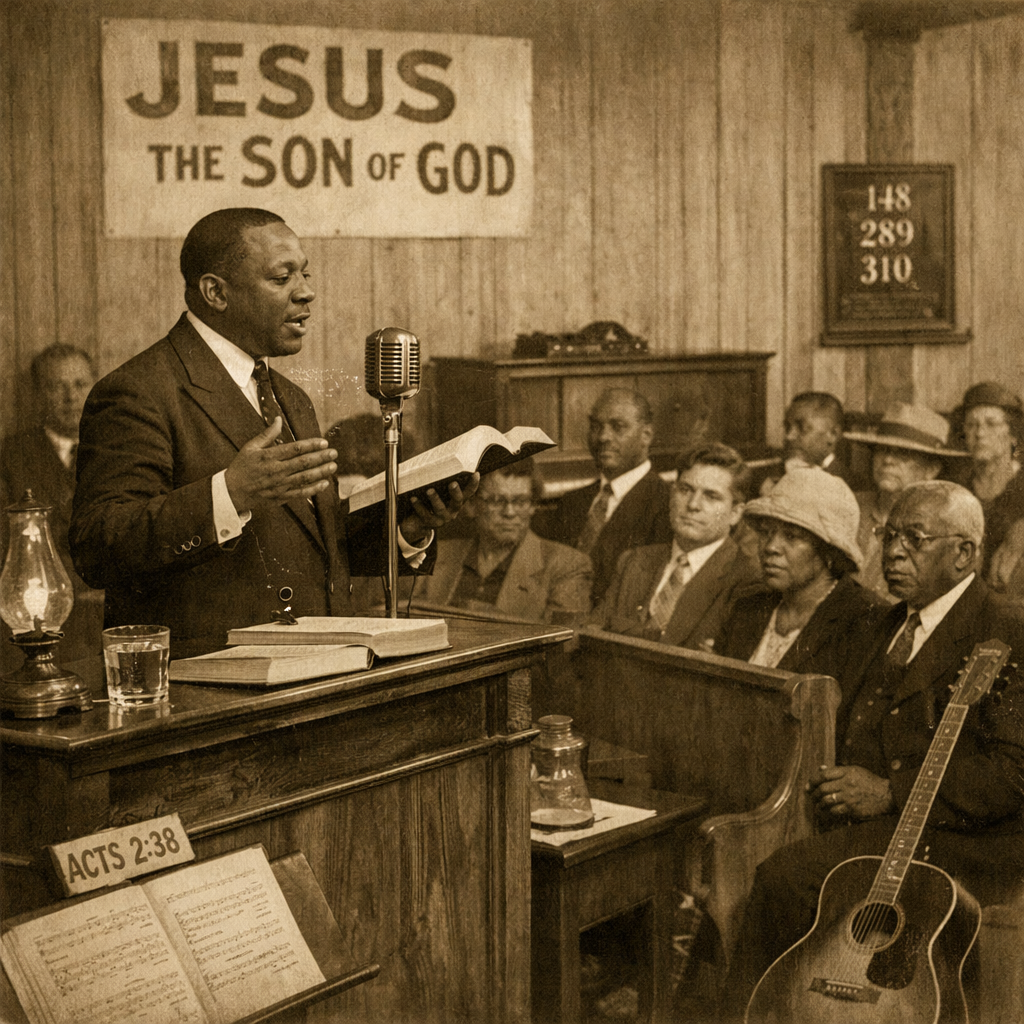
He married Daisy L. Haywood and built both a family and a congregation. Christ Temple in Indianapolis became one of the largest Pentecostal churches in the nation during his lifetime. His leadership was not itinerant celebrity. It was rooted pastoral investment.
Then came 1906.
The Azusa Street Revival under William J. Seymour ignited interracial Pentecostalism in Los Angeles. Black and white believers worshiped together in ways that defied Jim Crow logic. The Spirit fell without consulting segregation statutes.
Out of that revival climate, ministers formed what would become the Pentecostal Assemblies of the World (PAW). In its earliest years, the PAW was interracial, cooperative, and hopeful — credentialing ministers, organizing missions, and structuring revival into durable fellowship.
In 1913, a doctrinal tremor reshaped the movement. A sermon emphasizing baptism in the Name of Jesus sparked theological debate. Leaders like Frank Ewart advanced what became known as Oneness theology. By 1916, the Assemblies of God formally rejected this teaching, and Oneness ministers were expelled.
Many found refuge in the Pentecostal Assemblies of the World.
It was in this environment that Haywood rose to national prominence.
A Black bishop elected to high office within an interracial body during the height of segregation was not socially ordinary. It was spiritually disruptive.
For a brief season, the PAW embodied a radical possibility. Black and white ministers were credentialed together. Councils were shared. Authority structures were intertwined.
Acts 2 seemed to breathe inside Jim Crow America.
But culture pushes back.
