


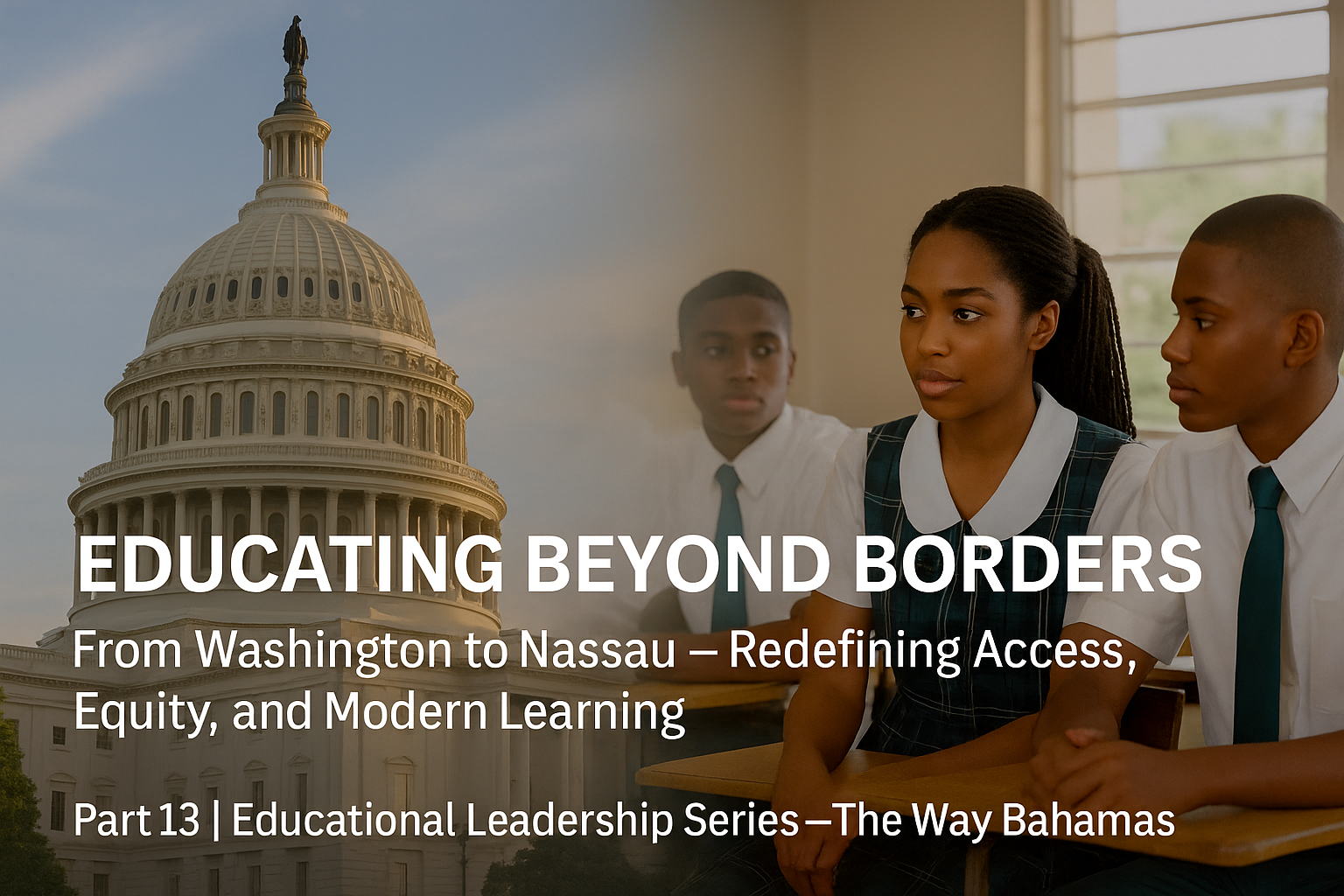
Part 13 | Educational Leadership Series – The Way Bahamas
From Washington to Nassau — Redefining Access, Equity, and Modern Learning
As the U.S. shifts toward state-led education and market-driven credentials, Caribbean nations face similar crossroads—balancing central control with local innovation. What can The Bahamas, Jamaica, and the wider region learn from America’s education reset?
A Global Shake-Up
When President Trump vowed to “send all education work back to the states,” analysts warned of ripple effects far beyond Washington . The idea—shrinking federal oversight and expanding state autonomy—could redefine who funds, governs, and benefits from schooling.
For the U.S., it may mean flexibility; for developing regions like the Caribbean, it highlights an urgent question: How do we democratize education while protecting quality and access?
The Age of the Modern Learner
U.S. think tanks describe today’s landscape as “the Era of the Modern Learner” — students pursuing stackable credentials, apprenticeships, and digital micro-degrees .
In The Bahamas, Jamaica, and Trinidad & Tobago, similar trends emerge:
- Technical and Vocational Education Training (TVET) reforms are expanding career-oriented pathways.
- Online universities like UWI Open Campus and UB Online are mirroring U.S. competency-based models.
- Private-sector partnerships—especially in tourism, maritime, and fintech—now shape curriculum design.
Yet the challenge remains: ensuring equity so that modernization doesn’t privilege the few.
