


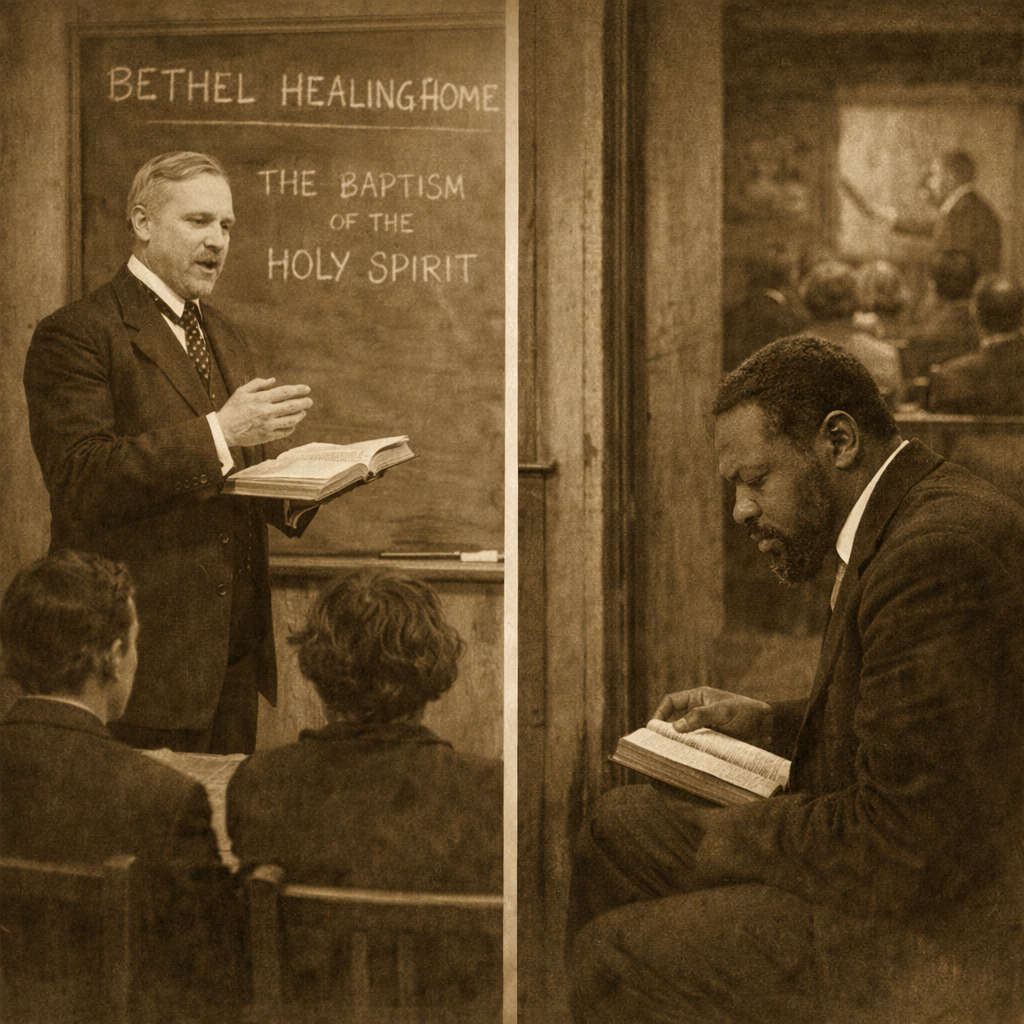
Charles Parham, William Seymour, and the Birth of a Pentecostal Doctrine
Before Azusa Street erupted in global revival, before Haywood structured councils, before the Caribbean carried the fire across islands — there was a classroom in Topeka, Kansas.
And there was a question.
What is the evidence that a believer has received the baptism of the Holy Spirit?
The man asking it was Charles F. Parham.
Charles Parham: The Seeker Who Asked the Question
Charles Fox Parham was born in 1873 in Iowa and raised in Kansas. He came out of the Holiness movement, a revival stream that emphasized sanctification, divine healing, and expectancy for spiritual renewal.
Parham was not satisfied with inherited theology.
He wanted apostolic restoration.
In 1900, he founded Bethel Bible College in Topeka, Kansas — a small, informal Bible training school. His method was simple but radical: instead of lecturing extensively, he assigned students to search the Book of Acts and determine what the apostles experienced when they received the Holy Spirit.
On New Year’s Eve 1900, a student named Agnes Ozman reportedly began speaking in tongues after prayer for Spirit baptism.
Parham concluded:
Speaking in tongues was the initial evidence of the baptism of the Holy Spirit.
That doctrinal formulation would become foundational to classical Pentecostalism.
It was not yet a global movement.
But the spark had been struck.
