


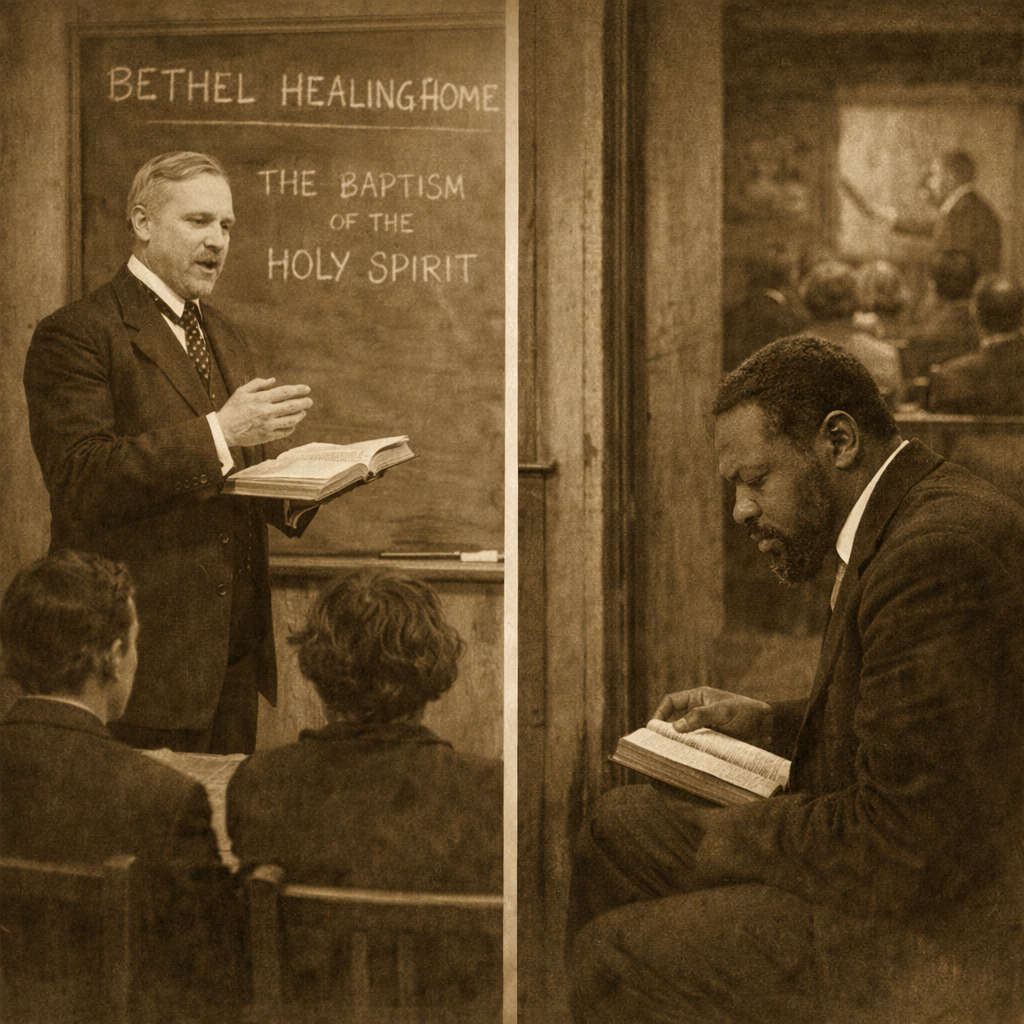
Enter William Seymour
A few years later, in 1905, a young Black preacher named William J. Seymour arrived in Houston, Texas, where Parham was teaching.
Because of segregation laws, Seymour could not sit in the classroom with white students.
He sat in the hallway.
Listening.
Absorbing.
Learning.
Imagine the irony.
The doctrine that would ignite interracial revival was being taught in a segregated building.
Parham taught that speaking in tongues was the initial evidence of Spirit baptism. Seymour embraced that theology. He did not initially speak in tongues himself — but he believed it was biblically grounded.
Their relationship at this stage was teacher and student.
Parham provided doctrinal clarity.
Seymour carried spiritual hunger.
Azusa: When the Student Surpassed the Teacher
In 1906, Seymour was invited to preach in Los Angeles. He delivered Parham’s teaching on Spirit baptism — but controversy erupted. He was locked out of the church.
So he prayed in a home.
And then the Spirit fell.
What began at Bonnie Brae Street moved to 312 Azusa Street — a converted warehouse that would host one of the most significant revival movements in modern church history.
Here is where the story becomes complicated.
Azusa Street exploded in ways Parham did not anticipate.
People spoke in tongues.
They testified.
They worshiped without rigid order.
Black and white believers knelt together.
Women preached.
The poor and educated shared space.
Seymour emphasized humility and unity.
Parham emphasized doctrinal precision and order.
When Parham visited Azusa, he was disturbed by what he perceived as emotional excess and lack of structured leadership. He criticized aspects of the revival. He objected to interracial worship in ways that reflected his cultural conditioning.
The relationship fractured.
The teacher and student parted ways.
