


The struggle culminated in the Battle of Siffin in 657, where Ali’s forces confronted those of the Syrian governor Muawiyah. Though the battle ended inconclusively, the conflict fractured the unity of the early Muslim community.
Only a few years later, tragedy struck again. In 661 AD, Ali himself was assassinated while praying in a mosque in Kufa. With his death, the caliphate passed to Muawiyah, who established the Umayyad dynasty, transforming the caliphate into a hereditary monarchy.
For the followers of Ali, this development represented a betrayal of the Prophet’s legacy.
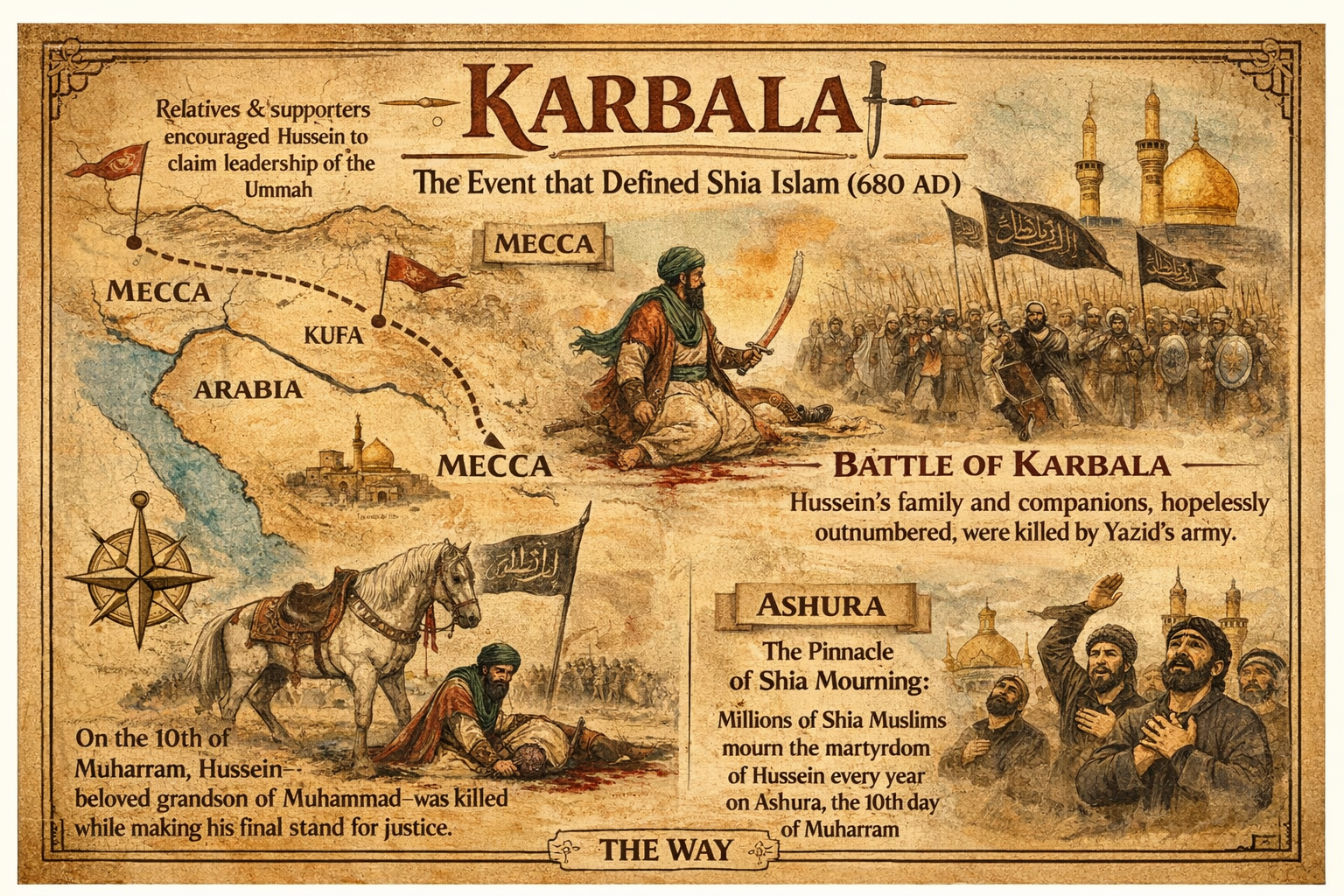
The defining moment for this group came two decades later in 680 AD, in an event that still echoes powerfully in the Shiite imagination. Ali’s son Hussein refused to pledge allegiance to the Umayyad ruler Yazid. Traveling with a small band of supporters and family members, Hussein was intercepted near the Iraqi town of Karbala.
Outnumbered and surrounded, Hussein and his followers were killed in a brutal confrontation. His death became a symbol of sacrifice, injustice, and resistance to tyranny.
For Shiite Muslims, the martyrdom of Hussein at Karbala represents one of the most sacred moments in their religious history. Each year, during the observance of Ashura, Shiite communities commemorate Hussein’s death through mourning rituals that remember his stand for justice.
Over time, the followers of Ali became known as Shi‘at Ali, meaning “the party of Ali.” From this phrase the word Shiite emerged.
Shiite Islam developed a distinctive theology centered on the concept of divinely guided leaders known as Imams. These Imams were believed to possess unique spiritual authority and insight into God’s will. The largest branch of Shiite Islam recognizes a line of twelve Imams, tracing their leadership through the descendants of Ali and Hussein.
According to Shiite belief, the twelfth Imam disappeared in the ninth century and entered a state of occultation, or hiddenness. Shiites believe this Hidden Imam will one day return to establish justice and restore the true order of the Islamic community.
