


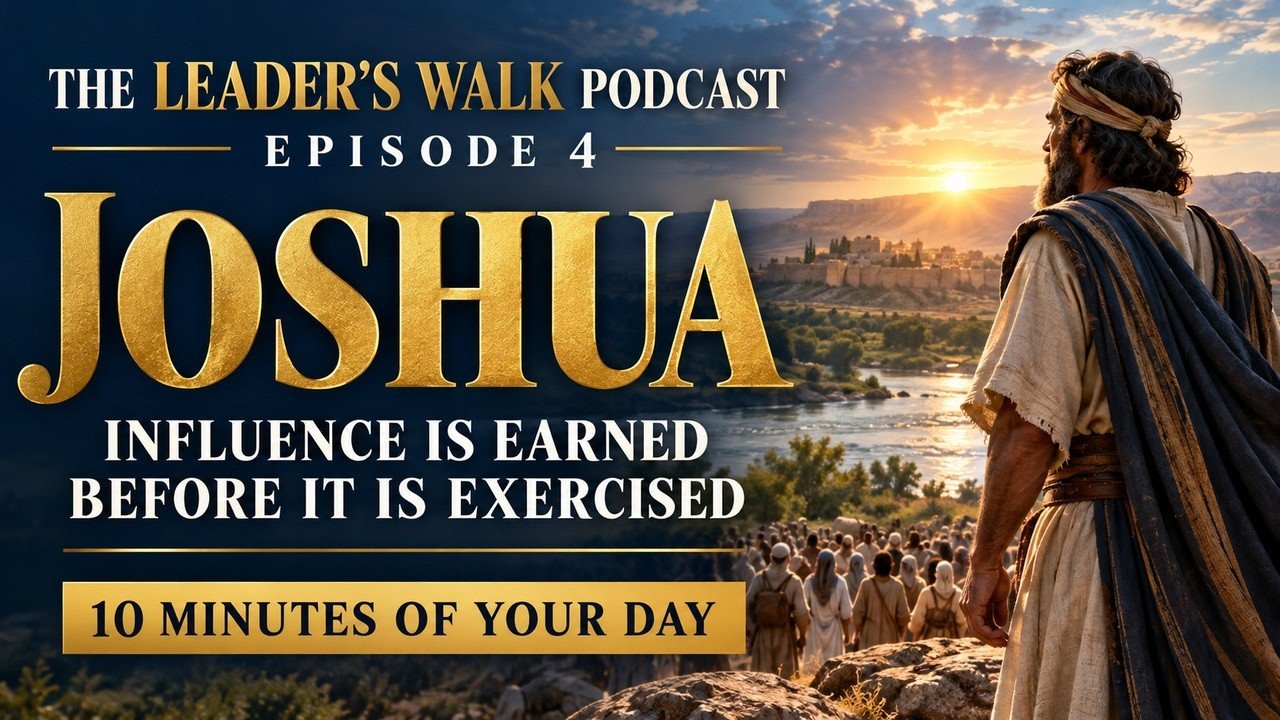
Authority can be assigned in a moment. Influence is earned over time. Joshua’s story demonstrates that lasting leadership grows through years of faithful service, courageous obedience, and tested character.
In The Leader’s Walk Podcast, Episode 4—“Joshua: Influence Is Earned Before It Is Exercised”—we trace the formation of a leader who eventually guided Israel into the promised land. Joshua’s public authority was visible at the Jordan, but its foundation had been laid long before.
Faithfulness Before Visibility
Joshua first appears as a servant, warrior, and assistant to Moses. He remained near the tent of meeting, learned beside his mentor, and accepted assignments that tested his courage. None of these seasons looked like the final role, yet every one of them contributed to it.
Leaders often underestimate the formative power of supporting another person’s mission. Joshua did not treat service as a delay in his leadership. Service was his leadership school.
Courage Rooted in Conviction
When ten spies focused on the danger in Canaan, Joshua and Caleb held to a different conclusion. They saw the challenge, but they trusted God’s promise more than the size of the opposition. Their courage was not denial. It was confidence rooted in conviction.
At first, Joshua’s influence was not strong enough to move the nation. Yet he did not abandon the truth or become bitter. He kept growing. Decades later, when he called the people forward, they were ready to follow.
Mentorship and Transferred Trust
Moses’ investment also shaped Joshua’s credibility. Joshua received instruction, proximity, correction, opportunity, and eventually a public commission. Healthy mentors do more than teach skills; they open space for emerging leaders to practice responsibility and receive trust.
Emerging leaders must also choose humility. Joshua did not inherit Moses’ relationship with God. He developed his own. Mentorship supported his growth, but it could not replace personal faithfulness.
Influence Begins at Home
Near the end of his life, Joshua declared, “As for me and my house, we will serve the Lord.” His national leadership remained connected to his household commitments. Public influence without private integrity is unstable. Leadership becomes durable when the values proclaimed publicly are practiced at home.
Four Practices That Build Influence
- Serve faithfully before you are seen.
- Choose conviction when the majority is afraid.
- Learn from mentors without borrowing their spiritual life.
- Lead your household and closest relationships with integrity.
Reflection Questions
- Where are you being formed through service right now?
- What difficult truth must you continue to live even when others resist it?
- Does your leadership at home support the message you present publicly?
Watch Episode 4 on YouTube: Joshua: Influence Is Earned Before It Is Exercised
Explore every episode: The Leader’s Walk Podcast at The Way Bible Institute
If this reflection encouraged you, share it with a leader, subscribe to the program, and follow The Way on YouTube, Facebook, TikTok, and wherever you listen.
This original reflection is inspired by leadership principles discussed by John C. Maxwell. Scripture focus: Numbers 13–14; Exodus 33:11; Deuteronomy 31:7–8; Joshua 1:1–9; 24:14–18.
