


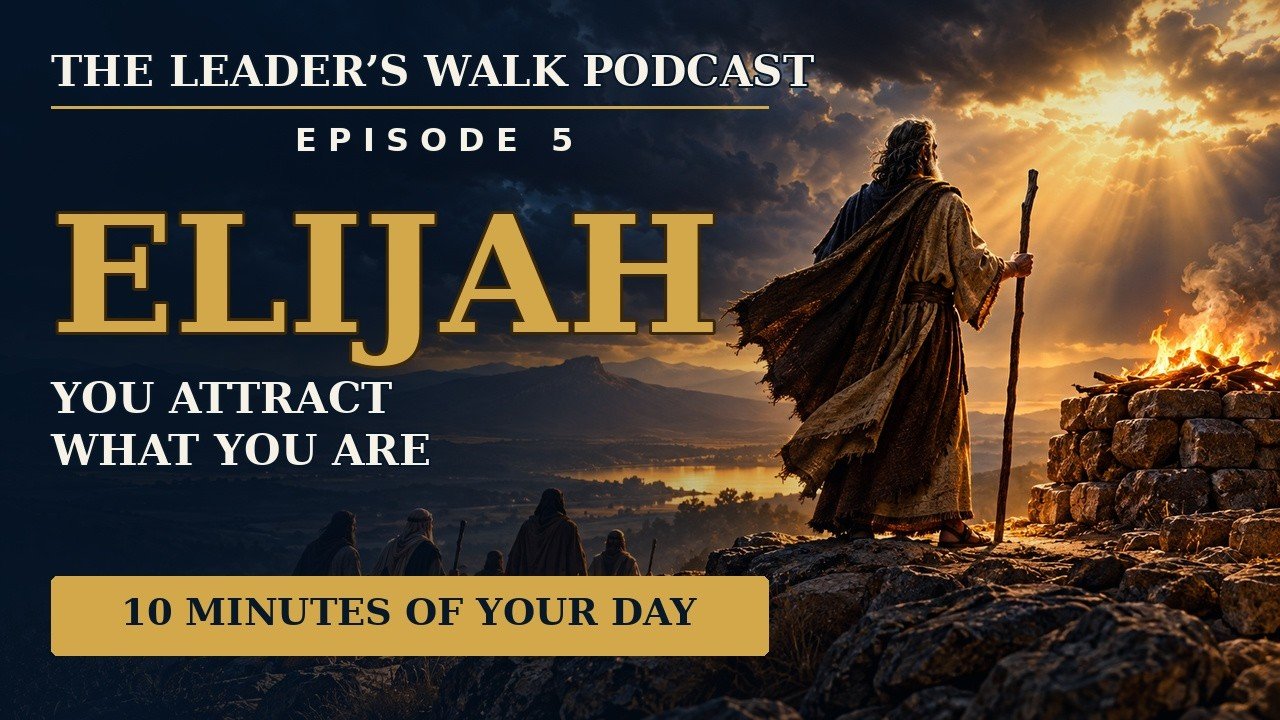
Who you are shapes who you attract. Elijah’s public courage was unmistakable, but the deeper story of his leadership began long before the confrontation on Mount Carmel. His life reminds us that influence grows from the character, convictions, and spiritual life a leader consistently embodies.
In Episode 5 of The Leader’s Walk Podcast, we explore Elijah’s journey through 1 Kings 17–19 and 2 Kings 2 through the Law of Magnetism: leaders often attract people who reflect what they value and model.
Leadership attraction begins within
Elijah did not become influential by manufacturing an image. He became compelling because his life carried conviction. He trusted God in obscurity, obeyed difficult instructions, served a widow and her household, confronted false worship, and remained committed to truth even when doing so was costly.
People are drawn not only to what leaders say, but also to the spirit, priorities, and patterns those leaders display. A leader who values prayer tends to gather people who recognize the importance of prayer. A leader who prizes truth attracts people who want to stand firmly in truth. A leader who models courage gives others permission to become courageous.
Elijah and Elisha: attraction with purpose
When Elijah called Elisha in 1 Kings 19:19–21, Elisha responded decisively. Their connection was not based merely on personality. It rested on shared devotion, purpose, expectation, contribution, and commitment. Elijah offered mentorship and a life worth observing; Elisha brought teachability, sacrifice, and a willingness to serve.
Healthy leadership magnetism does not create admirers who remain dependent. It forms people who can carry the mission forward. Elisha eventually received Elijah’s mantle and continued the work with courage and faith.
Magnetism must be governed by character
Influence is a tool. It can gather people around what is true and life-giving, or it can draw them toward a leader’s insecurity, ambition, and unexamined weakness. That is why growing influence must be matched by growing character.
The people around us often reveal something about the culture we are creating. If we consistently attract fear, rivalry, passivity, or confusion, wisdom invites us to examine what our leadership may be rewarding. If we desire people of integrity, generosity, courage, and spiritual depth, we must keep becoming that kind of person ourselves.
Four questions for personal formation
- What qualities are the people closest to me experiencing consistently?
- Am I attracting people who merely agree with me, or people who strengthen the mission?
- Where do I need complementary gifts rather than another person just like me?
- What private discipline would make my public leadership healthier?
A practical step for this week
Identify one quality you hope to see more clearly in your team, ministry, family, or organization. Before asking others to demonstrate it, choose one concrete way to model it yourself. Leadership transformation begins when the desired culture becomes visible in the leader.
Read Elijah’s story in 1 Kings 17–19 and 2 Kings 2. This original reflection is inspired by leadership principles discussed by John C. Maxwell, including the Law of Magnetism.
Continue the journey: Visit The Leader’s Walk Podcast page for this episode and related leadership resources. Watch Episode 5 on YouTube, and share it with a leader who is shaping the culture around them.
The Leader’s Walk Podcast offers ten minutes of your day to strengthen the way you lead and the way you live. Walking in Truth • Walking Together.
